<?xml version="1.0" encoding="utf-8"?><feed xmlns="http://www.w3.org/2005/Atom" ><generator uri="https://jekyllrb.com/" version="3.10.0">Jekyll</generator><link href="https://blog.sepaone.com/feed.xml" rel="self" type="application/atom+xml" /><link href="https://blog.sepaone.com/" rel="alternate" type="text/html" /><updated>2026-08-23T21:16:22+00:00</updated><id>https://blog.sepaone.com/feed.xml</id><title type="html">SEPAone Blog</title><subtitle>SEPA Direct Debit — Artikel und Hintergründe</subtitle><entry><title type="html">PSD2 RTS spares SDD – concentration in payment market and insecure payments are pushed</title><link href="https://blog.sepaone.com/2017/07/01/psd2-rts-spares-sdd-concentration-in-payment-market-and-insecure-payments-are-pushed/" rel="alternate" type="text/html" title="PSD2 RTS spares SDD – concentration in payment market and insecure payments are pushed" /><published>2017-07-01T16:46:10+00:00</published><updated>2017-07-01T16:46:10+00:00</updated><id>https://blog.sepaone.com/2017/07/01/psd2-rts-spares-sdd-concentration-in-payment-market-and-insecure-payments-are-pushed</id><content type="html" xml:base="https://blog.sepaone.com/2017/07/01/psd2-rts-spares-sdd-concentration-in-payment-market-and-insecure-payments-are-pushed/"><![CDATA[<p>EBA made clear in their final draft of the RTS that SDD is not part of their regulation:</p>
<p>&#8220;In relation to payment instruments, and as stated in the CP, the EBA understands that Article 97(1)(b) applies to electronic payments initiated by the payer, or by the payer through the payee such as credit transfers or card payments, but does not apply to electronic payments initiated by the payee only. Given Article 97(1)(c), an exception is a transaction where the payer’s consent for a direct debit transaction is given in the form of an electronic mandate with the involvement of its PSP. The different types of payment instruments include e-money payment transactions. For instance, credit transfers include e-money transfers.&#8221;</p>
<p>and</p>
<p>&#8220;With regards to direct debits, the EBA notes that they are out of the scope of the RTS as they are initiated by the payee.&#8221;</p>
<p>Even though the Commission has communicated its intention to amend to the RTS there is no comment on direct debit and SEPA DD mandates.</p>
<p>My conclusion is that PayPal, Amazon Payment, and SEPA DD will be pushed by many online businesses as UX with 2FA for credit card will drop conversion.</p>
<p>And even click-mandates seem to survive: So as a result of PSD2, we will observe concentration in online payment and more insecure direct debit payments &#8211; not exactly what was intended by the EBA.</p>
<p>Related documents:</p>
<ul>
<li><a href="https://www.eba.europa.eu/documents/10180/1761863/Final+draft+RTS+on+SCA+and+CSC+under+PSD2+%28EBA-RTS-2017-02%29.pdf" target="_blank" rel="noopener">Final Report Draft Regulatory Technical Standards</a></li>
<li><a title="EBA Opinion on the amended text of the RTS on SCA and CSC (EBA-Op-2017-09)" href="http://www.eba.europa.eu/documents/10180/1894900/EBA+Opinion+on+the+amended+text+of+the+RTS+on+SCA+and+CSC+%28EBA-Op-2017-09%29.pdf" target="_blank" rel="noopener">EBA Opinion on the amended text of the RTS on SCA and CSC (EBA-Op-2017-09)</a></li>
<li><a title="(EBA-2017-E-1315) Letter from O Guersent, FISMA re Commission intention to amend the draft RTS on SCA and CSC -Ares(2017)2639906" href="http://www.eba.europa.eu/documents/10180/1863077/%28EBA-2017-E-1315%29%20Letter+from+O+Guersent%2C%20FISMA+re+Commission+intention+to+amend+the+draft+RTS+on+SCA+and+CSC+-Ares%282017%292639906.pdf" target="_blank" rel="noopener">(EBA-2017-E-1315) Letter from O Guersent, FISMA re Commission intention to amend the draft RTS on SCA and CSC -Ares(2017)2639906</a></li>
</ul>]]></content><author><name></name></author><summary type="html"><![CDATA[EBA made clear in their final draft of the RTS that SDD is not part of their regulation: &#8220;In relation to payment instruments, and as stated in the CP, the EBA understands that Article 97(1)(b) applies to electronic payments initiated by the payer, or by the payer through the payee such as credit transfers or card payments, but does not apply to electronic payments initiated by the payee only. Given Article 97(1)(c), an exception is a transaction where the payer’s consent for a direct debit transaction is given in the form of an electronic mandate with the involvement of its PSP. The different types of payment instruments include e-money payment transactions. For instance, credit transfers include e-money transfers.&#8221; and &#8220;With regards to direct debits, the EBA notes that they are out of the scope of the RTS as they are initiated by the payee.&#8221; Even though the Commission has communicated its intention to amend to the RTS there is no comment on direct debit and SEPA DD mandates. My conclusion is that PayPal, Amazon Payment, and SEPA DD will be pushed by many online businesses as UX with 2FA for credit card will drop conversion. And even click-mandates seem to survive: So as a result of PSD2, we will observe concentration in online payment and more insecure direct debit payments &#8211; not exactly what was intended by the EBA. Related documents: Final Report Draft Regulatory Technical Standards EBA Opinion on the amended text of the RTS on SCA and CSC (EBA-Op-2017-09) (EBA-2017-E-1315) Letter from O Guersent, FISMA re Commission intention to amend the draft RTS on SCA and CSC -Ares(2017)2639906]]></summary></entry><entry><title type="html">Don’t like typing IBAN on mobile devices? Scan it in 3 seconds!</title><link href="https://blog.sepaone.com/2015/12/02/dont-like-typing-iban-on-mobile-devices-scan-it-in-3-seconds/" rel="alternate" type="text/html" title="Don’t like typing IBAN on mobile devices? Scan it in 3 seconds!" /><published>2015-12-02T12:34:53+00:00</published><updated>2015-12-02T12:34:53+00:00</updated><id>https://blog.sepaone.com/2015/12/02/dont-like-typing-iban-on-mobile-devices-scan-it-in-3-seconds</id><content type="html" xml:base="https://blog.sepaone.com/2015/12/02/dont-like-typing-iban-on-mobile-devices-scan-it-in-3-seconds/"><![CDATA[<p><span class="embed-youtube" style="text-align:center; display: block;">&lt;iframe class="youtube-player" width="640" height="360" src="https://www.youtube.com/embed/V9qfIZ4lsAQ?version=3&#038;rel=1&#038;showsearch=0&#038;showinfo=1&#038;iv_load_policy=1&#038;fs=1&#038;hl=en&#038;autohide=2&#038;wmode=transparent" allowfullscreen="true" style="border:0;" sandbox="allow-scripts allow-same-origin allow-popups allow-presentation allow-popups-to-escape-sandbox"&gt;&lt;/iframe&gt;</span></p>
<p>Use our new SDK (iOS and Android) for mobile IBAN entry. We used our experience from a project with Fraunhofer IPK and liveIDENT.com in recognizing holograms from id cards.</p>
<p>But why does it work so fast and seamless? The answer is easy. Optimized computer vision code is executed on the mobile device itself. So there is no picture or video sent to a server and you&#8217;re not dependent on network bandwidth.</p>
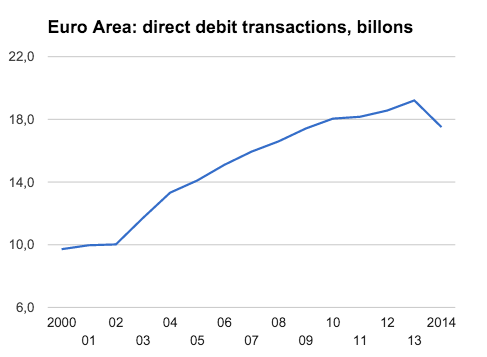
<p>We love it. You&#8217;re gonna love it too. Try it now. Send an email to SDK@SEPAone.com</p>]]></content><author><name></name></author><summary type="html"><![CDATA[&lt;iframe class="youtube-player" width="640" height="360" src="https://www.youtube.com/embed/V9qfIZ4lsAQ?version=3&#038;rel=1&#038;showsearch=0&#038;showinfo=1&#038;iv_load_policy=1&#038;fs=1&#038;hl=en&#038;autohide=2&#038;wmode=transparent" allowfullscreen="true" style="border:0;" sandbox="allow-scripts allow-same-origin allow-popups allow-presentation allow-popups-to-escape-sandbox"&gt;&lt;/iframe&gt; Use our new SDK (iOS and Android) for mobile IBAN entry. We used our experience from a project with Fraunhofer IPK and liveIDENT.com in recognizing holograms from id cards. But why does it work so fast and seamless? The answer is easy. Optimized computer vision code is executed on the mobile device itself. So there is no picture or video sent to a server and you&#8217;re not dependent on network bandwidth. We love it. You&#8217;re gonna love it too. Try it now. Send an email to SDK@SEPAone.com]]></summary></entry><entry><title type="html">Direct Debit loosing relevance or migration hick up?</title><link href="https://blog.sepaone.com/2015/11/24/direct-debit-loosing-relevance-or-migration-hick-up/" rel="alternate" type="text/html" title="Direct Debit loosing relevance or migration hick up?" /><published>2015-11-24T16:22:32+00:00</published><updated>2015-11-24T16:22:32+00:00</updated><id>https://blog.sepaone.com/2015/11/24/direct-debit-loosing-relevance-or-migration-hick-up</id><content type="html" xml:base="https://blog.sepaone.com/2015/11/24/direct-debit-loosing-relevance-or-migration-hick-up/"><![CDATA[<p>The European Central Bank (ECB) has published Oct 15th the <a href="https://www.google.com/url?q=https://www.ecb.europa.eu/press/pdf/pis/pis2014.en.pdf%3Fcc76d69278273dab818bf4c7465e9439&amp;sa=U&amp;ved=0ahUKEwjRw8TU_6jJAhXKjCwKHWLDCTIQFggFMAA&amp;client=internal-uds-cse&amp;usg=AFQjCNFhR0qenVm4JHaw87PyfwWbRO40sg" target="_blank">2014 statistics on non-cash payments</a>. Surprisingly the number of direct debits transactions were declining by almost 12%  in the Euro area to 17.8 billion. That was the first time since the ECB is measuring this data:</p>
<p><img data-attachment-id="257" data-permalink="http://blog.sepaone.com/2015/11/24/direct-debit-loosing-relevance-or-migration-hick-up/bildschirmfoto-2015-11-24-um-13-37-44/" data-orig-file="/assets/images/bildschirmfoto-2015-11-24-um-13-37-44.png" data-orig-size="487,357" data-comments-opened="0" data-image-meta="{&quot;aperture&quot;:&quot;0&quot;,&quot;credit&quot;:&quot;&quot;,&quot;camera&quot;:&quot;&quot;,&quot;caption&quot;:&quot;&quot;,&quot;created_timestamp&quot;:&quot;0&quot;,&quot;copyright&quot;:&quot;&quot;,&quot;focal_length&quot;:&quot;0&quot;,&quot;iso&quot;:&quot;0&quot;,&quot;shutter_speed&quot;:&quot;0&quot;,&quot;title&quot;:&quot;&quot;,&quot;orientation&quot;:&quot;0&quot;}" data-image-title="Bildschirmfoto 2015-11-24 um 13.37.44" data-image-description="" data-image-caption="" data-large-file="/assets/images/bildschirmfoto-2015-11-24-um-13-37-44.png" loading="lazy" class="alignnone size-full wp-image-257" src="/assets/images/bildschirmfoto-2015-11-24-um-13-37-44.png" alt="Bildschirmfoto 2015-11-24 um 13.37.44" width="487" height="357" srcset="/assets/images/bildschirmfoto-2015-11-24-um-13-37-44.png 487w, /assets/images/bildschirmfoto-2015-11-24-um-13-37-44.png 150w, /assets/images/bildschirmfoto-2015-11-24-um-13-37-44.png 300w" sizes="auto, (max-width: 487px) 100vw, 487px" /></p>
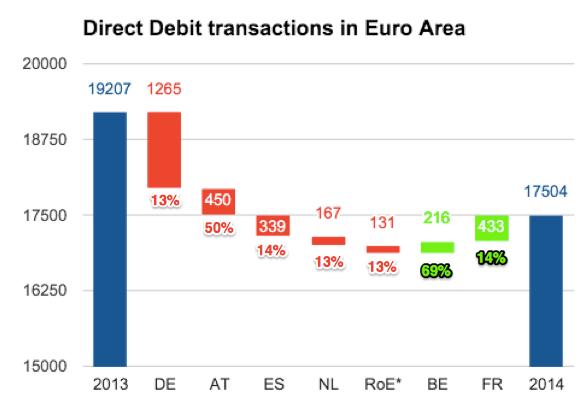
<p>So let&#8217;s have a look where the changes are coming from:</p>
<p><img data-attachment-id="266" data-permalink="http://blog.sepaone.com/2015/11/24/direct-debit-loosing-relevance-or-migration-hick-up/bildschirmfoto-2015-11-24-um-16-19-37/" data-orig-file="/assets/images/bildschirmfoto-2015-11-24-um-16-19-37.png" data-orig-size="581,405" data-comments-opened="0" data-image-meta="{&quot;aperture&quot;:&quot;0&quot;,&quot;credit&quot;:&quot;&quot;,&quot;camera&quot;:&quot;&quot;,&quot;caption&quot;:&quot;&quot;,&quot;created_timestamp&quot;:&quot;0&quot;,&quot;copyright&quot;:&quot;&quot;,&quot;focal_length&quot;:&quot;0&quot;,&quot;iso&quot;:&quot;0&quot;,&quot;shutter_speed&quot;:&quot;0&quot;,&quot;title&quot;:&quot;&quot;,&quot;orientation&quot;:&quot;0&quot;}" data-image-title="Bildschirmfoto 2015-11-24 um 16.19.37" data-image-description="" data-image-caption="" data-large-file="/assets/images/bildschirmfoto-2015-11-24-um-16-19-37.png" loading="lazy" class="alignnone size-full wp-image-266" src="/assets/images/bildschirmfoto-2015-11-24-um-16-19-37.png" alt="Bildschirmfoto 2015-11-24 um 16.19.37" width="581" height="405" srcset="/assets/images/bildschirmfoto-2015-11-24-um-16-19-37.png 581w, /assets/images/bildschirmfoto-2015-11-24-um-16-19-37.png 150w, /assets/images/bildschirmfoto-2015-11-24-um-16-19-37.png 300w" sizes="auto, (max-width: 581px) 100vw, 581px" /></p>
<p>milloins, % are country relative changes, <a href="http://www.ecb.europa.eu/stats/payments/paym/html/payments_p_index.en.html" target="_blank">Source ECB</a></p>
<p>3/4 of the effect comes from Germany 1/4 from Austria. France and Belgium cover for the other countries losses. Slimpay managers told us that growth in France came from checks being banned from some business areas. Especially growth of 69% in Belgium is remarkable. But what happened to Austria with a 50% decline?</p>
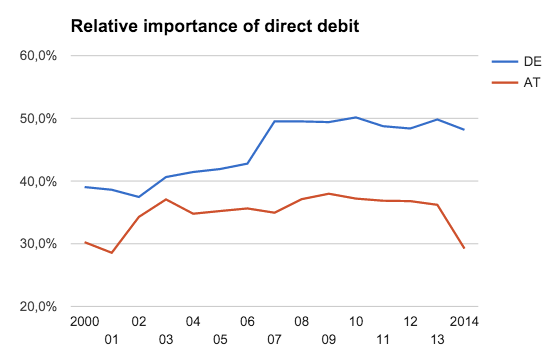
<p>Let&#8217;s dig a little bit deeper into Germany and Austria. Relative importance of direct debit is melting down:</p>
<p><img data-attachment-id="226" data-permalink="http://blog.sepaone.com/2015/11/24/direct-debit-loosing-relevance-or-migration-hick-up/bildschirmfoto-2015-11-24-um-13-08-54/" data-orig-file="/assets/images/bildschirmfoto-2015-11-24-um-13-08-54.png" data-orig-size="548,364" data-comments-opened="0" data-image-meta="{&quot;aperture&quot;:&quot;0&quot;,&quot;credit&quot;:&quot;&quot;,&quot;camera&quot;:&quot;&quot;,&quot;caption&quot;:&quot;&quot;,&quot;created_timestamp&quot;:&quot;0&quot;,&quot;copyright&quot;:&quot;&quot;,&quot;focal_length&quot;:&quot;0&quot;,&quot;iso&quot;:&quot;0&quot;,&quot;shutter_speed&quot;:&quot;0&quot;,&quot;title&quot;:&quot;&quot;,&quot;orientation&quot;:&quot;0&quot;}" data-image-title="Bildschirmfoto 2015-11-24 um 13.08.54" data-image-description="" data-image-caption="" data-large-file="/assets/images/bildschirmfoto-2015-11-24-um-13-08-54.png" loading="lazy" class="alignnone size-full wp-image-226" src="/assets/images/bildschirmfoto-2015-11-24-um-13-08-54.png" alt="Bildschirmfoto 2015-11-24 um 13.08.54" width="548" height="364" srcset="/assets/images/bildschirmfoto-2015-11-24-um-13-08-54.png 548w, /assets/images/bildschirmfoto-2015-11-24-um-13-08-54.png 150w, /assets/images/bildschirmfoto-2015-11-24-um-13-08-54.png 300w" sizes="auto, (max-width: 548px) 100vw, 548px" /><a href="http://www.ecb.europa.eu/stats/payments/paym/html/payments_p_index.en.html" target="_blank">Source ECB</a></p>
<p>Some market participants argue credit card transactions are coming back because of lower interchange fees. This might be a valid argument. But it would be much to early to find in 2014 numbers. The contrary is true since also card transactions declined by 8% in 2014 in Germany and Austria.</p>
<p><strong>&#8220;SEPA migration failed&#8221;</strong></p>
<p>We have asked the <a href="http://www.oenb.at">Austrian Central Bank</a> for statistical explanation to the 50% decline in direct debit transactions. They seem not to know the reason and doubt that the 2013 numbers where right because they where sourced by a 3rd party, partly wild guessing the figures.</p>
<p>The central bank&#8217;s <a href="https://www.oenb.at/Publikationen/Oesterreichische-Nationalbank/Geschaeftsbericht.html">2014 report</a> does not comment on the issue. The ECB categorizes the Austrian SEPA migration with &#8220;minor resolvable issues&#8221; which sounds euphemistic. We have to state that SEPA migration or stats failed in Austria. Financial institution did not offer their clients a smooth path to a well working European payment scheme.</p>
<p>But it&#8217;s unfair to point at the banking system only. We have observed that merchants and payment service providers where suffering from regulatory uncertainty about how to receive a direct debit mandate. We didn&#8217;t see much improvement in direct debit payment solutions in the industry (excluding perhaps Paydirekt, GoCardless and a Stripe balloon test).</p>
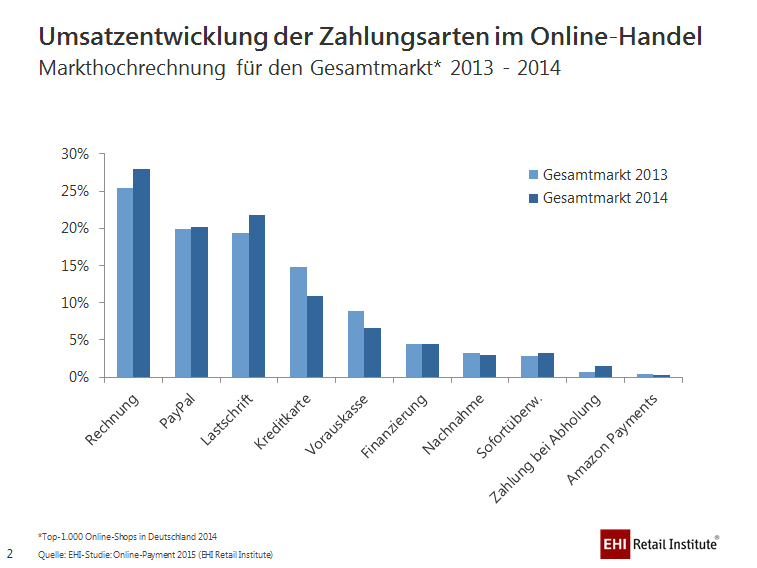
<p>Our hope is that we will see a recovery in 2015 and 2016 numbers since the German regulator announced Oct 30 2015 in a <a href="http://www.bafin.de/SharedDocs/Downloads/DE/FAQ/dl_faq_rs_1504_ba.html">FAQ document,</a> that mandates can be received in the future as we know it &#8211; with a klick in a checkbox.</p>]]></content><author><name></name></author><summary type="html"><![CDATA[The European Central Bank (ECB) has published Oct 15th the 2014 statistics on non-cash payments. Surprisingly the number of direct debits transactions were declining by almost 12%  in the Euro area to 17.8 billion. That was the first time since the ECB is measuring this data: So let&#8217;s have a look where the changes are coming from: milloins, % are country relative changes, Source ECB 3/4 of the effect comes from Germany 1/4 from Austria. France and Belgium cover for the other countries losses. Slimpay managers told us that growth in France came from checks being banned from some business areas. Especially growth of 69% in Belgium is remarkable. But what happened to Austria with a 50% decline? Let&#8217;s dig a little bit deeper into Germany and Austria. Relative importance of direct debit is melting down: Source ECB Some market participants argue credit card transactions are coming back because of lower interchange fees. This might be a valid argument. But it would be much to early to find in 2014 numbers. The contrary is true since also card transactions declined by 8% in 2014 in Germany and Austria. &#8220;SEPA migration failed&#8221; We have asked the Austrian Central Bank for statistical explanation to the 50% decline in direct debit transactions. They seem not to know the reason and doubt that the 2013 numbers where right because they where sourced by a 3rd party, partly wild guessing the figures. The central bank&#8217;s 2014 report does not comment on the issue. The ECB categorizes the Austrian SEPA migration with &#8220;minor resolvable issues&#8221; which sounds euphemistic. We have to state that SEPA migration or stats failed in Austria. Financial institution did not offer their clients a smooth path to a well working European payment scheme. But it&#8217;s unfair to point at the banking system only. We have observed that merchants and payment service providers where suffering from regulatory uncertainty about how to receive a direct debit mandate. We didn&#8217;t see much improvement in direct debit payment solutions in the industry (excluding perhaps Paydirekt, GoCardless and a Stripe balloon test). Our hope is that we will see a recovery in 2015 and 2016 numbers since the German regulator announced Oct 30 2015 in a FAQ document, that mandates can be received in the future as we know it &#8211; with a klick in a checkbox.]]></summary></entry><entry><title type="html">Direct Debit fastest growing E-Commerce Payment Method in DE, overtaking PayPal</title><link href="https://blog.sepaone.com/2015/05/15/direct-debit-fastest-growing-e-commerce-payment-method-in-de-overtaking-paypal/" rel="alternate" type="text/html" title="Direct Debit fastest growing E-Commerce Payment Method in DE, overtaking PayPal" /><published>2015-05-15T14:08:53+00:00</published><updated>2015-05-15T14:08:53+00:00</updated><id>https://blog.sepaone.com/2015/05/15/direct-debit-fastest-growing-e-commerce-payment-method-in-de-overtaking-paypal</id><content type="html" xml:base="https://blog.sepaone.com/2015/05/15/direct-debit-fastest-growing-e-commerce-payment-method-in-de-overtaking-paypal/"><![CDATA[<p>Concerning E-Commerce payment behaviour in Germany today we have a closer look at the 2014 <a href="http://www.ehi-shop.de/de/handelsthemen/e-commerce/studie-e-commerce-markt-deutschland-2014">EHI Retail Institute numbers</a>.</p>
<p>German E-commerce buyers prefer payment upon invoice since many years. This is no news. 28% of E-Commece Revenue is payed after delivery by bank transfer. This might be secure and cash saving for buyers but expensive for merchants. Invoice is by far more expensive if you include direct and indirect costs as debtor management and default. IBI Research has calculated more than € 8 per transaction (Source: <a href="https://www.derhandel.de/news/technik/pages/pdfs/352_org.pdf">Total costs of payment methods 2014</a>).</p>
<p>The real news is that direct debit is growing fastest with 13% (or 2.5% points) to 22% overtaking PayPal (20%). Direct debit is now no 2 preferred payment method in E-Commerce. This is great for merchants because direct debit is cheapest payment method after Sofort Überweisung. IBI calculates under € 2 per transaction for Sofort and € 4.41 for direct debit. With SEPAone we think we can lower these costs to a level around € 2.50 for small merchants, undercutting credit cards and PayPal by far.</p>
<p><a href="/assets/images/onlinepayment_2.jpg"><img data-attachment-id="176" data-permalink="http://blog.sepaone.com/2015/05/15/direct-debit-fastest-growing-e-commerce-payment-method-in-de-overtaking-paypal/onlinepayment_2/" data-orig-file="/assets/images/onlinepayment_2.jpg" data-orig-size="757,568" data-comments-opened="0" data-image-meta="{&quot;aperture&quot;:&quot;0&quot;,&quot;credit&quot;:&quot;&quot;,&quot;camera&quot;:&quot;&quot;,&quot;caption&quot;:&quot;&quot;,&quot;created_timestamp&quot;:&quot;0&quot;,&quot;copyright&quot;:&quot;&quot;,&quot;focal_length&quot;:&quot;0&quot;,&quot;iso&quot;:&quot;0&quot;,&quot;shutter_speed&quot;:&quot;0&quot;,&quot;title&quot;:&quot;&quot;,&quot;orientation&quot;:&quot;0&quot;}" data-image-title="Onlinepayment_2" data-image-description="" data-image-caption="" data-large-file="/assets/images/onlinepayment_2.jpg" loading="lazy" class="alignnone  wp-image-176" src="/assets/images/onlinepayment_2.jpg" alt="Onlinepayment_2" width="787" height="593" srcset="/assets/images/onlinepayment_2.jpg 300w, /assets/images/onlinepayment_2.jpg 150w" sizes="auto, (max-width: 787px) 100vw, 787px" /></a></p>
<p>But why is direct debit rising now? There is no marketing campaign for direct debit. One argument discussed at the EHI Card Congress in Bonn last week was that regulatory uncertainty around SEPA is now over and merchants now invest in optimizing their payment portfolio. This sounds plausible to me. The number of top 1000 merchant, offering direct debit, increased 2014 compared to 2013.</p>
<p>Another strong effect might be the Amazon effect. Amazon uses direct debit as their main payment method and Amazon revenue is waited strongly in the top 1000 E-Commerce EHI numbers.</p>
<p>So let&#8217;s do it like Amazon and offer direct debit to our buyers.</p>]]></content><author><name></name></author><summary type="html"><![CDATA[Concerning E-Commerce payment behaviour in Germany today we have a closer look at the 2014 EHI Retail Institute numbers. German E-commerce buyers prefer payment upon invoice since many years. This is no news. 28% of E-Commece Revenue is payed after delivery by bank transfer. This might be secure and cash saving for buyers but expensive for merchants. Invoice is by far more expensive if you include direct and indirect costs as debtor management and default. IBI Research has calculated more than € 8 per transaction (Source: Total costs of payment methods 2014). The real news is that direct debit is growing fastest with 13% (or 2.5% points) to 22% overtaking PayPal (20%). Direct debit is now no 2 preferred payment method in E-Commerce. This is great for merchants because direct debit is cheapest payment method after Sofort Überweisung. IBI calculates under € 2 per transaction for Sofort and € 4.41 for direct debit. With SEPAone we think we can lower these costs to a level around € 2.50 for small merchants, undercutting credit cards and PayPal by far. But why is direct debit rising now? There is no marketing campaign for direct debit. One argument discussed at the EHI Card Congress in Bonn last week was that regulatory uncertainty around SEPA is now over and merchants now invest in optimizing their payment portfolio. This sounds plausible to me. The number of top 1000 merchant, offering direct debit, increased 2014 compared to 2013. Another strong effect might be the Amazon effect. Amazon uses direct debit as their main payment method and Amazon revenue is waited strongly in the top 1000 E-Commerce EHI numbers. So let&#8217;s do it like Amazon and offer direct debit to our buyers.]]></summary></entry><entry><title type="html">Will SecuRe Pay, MaSI and PSD 2 stop us from pulling Online Direct Debits?</title><link href="https://blog.sepaone.com/2015/05/11/will-secure-pay-masin-and-psd-2-stopp-us-from-pulling-online-direct-debits/" rel="alternate" type="text/html" title="Will SecuRe Pay, MaSI and PSD 2 stop us from pulling Online Direct Debits?" /><published>2015-05-11T16:23:18+00:00</published><updated>2015-05-11T16:23:18+00:00</updated><id>https://blog.sepaone.com/2015/05/11/will-secure-pay-masin-and-psd-2-stopp-us-from-pulling-online-direct-debits</id><content type="html" xml:base="https://blog.sepaone.com/2015/05/11/will-secure-pay-masin-and-psd-2-stopp-us-from-pulling-online-direct-debits/"><![CDATA[<p>May 5th 2015 German Regulator, BaFin has published <a href="http://www.bafin.de/SharedDocs/Veroeffentlichungen/DE/Rundschreiben/2015/rs_11504_ba_MA_Internetzahlungen.html?nn=2818068#doc6166312bodyText3">Minimum Requirements for the Safety of Internet Payments</a>. They are just a translation of <a href="http://www.eba.europa.eu/documents/10180/1004450/EBA_2015_DE+Guidelines+on+Internet+Payments.pdf/eff847ff-f1ed-4589-8efc-900cd78e2707">the Guidelines on the security of internet payments published by European Banking Authority (EBA)</a> and far behind the <a href="http://www.bafin.de/SharedDocs/Veroeffentlichungen/DE/Konsultation/2015/kon_0215_sicherheit_internetzahlungen.html">original BaFin draft</a>. Nevertheless the published circular letter dos not clarify, if online direct debit will remain compliant.</p>
<p>The letter refers to &#8220;E-Mandates&#8221; and not to so called Click-Mandates. So our understanding is that a mandate can be given by a click only. But our clients are irritated. Hence, we ask the German Ministry of Finance and the Bundesbank to clarify once more <a href="http://www.bundesbank.de/Redaktion/DE/Downloads/Presse/Pressenotizen/2013/2013_09_12_sepa_lastschriften.html">as they did in September 2013</a>.</p>
<p><span style="color:#ff0000;">Update 2015 Aug 26th:</span></p>
<p>Semi official clarification was published by BaFin saying that merchants can continue pulling generating mandates with a click but regulated PSPs are forced to do a two factor authentication. In addition we herd that BaFin might not force MaSI before PSD2. So Germany is following UK. What does that mean in practice? <strong>SEPA direct debit online and mobile is safe</strong> at least for another two years.</p>]]></content><author><name></name></author><summary type="html"><![CDATA[May 5th 2015 German Regulator, BaFin has published Minimum Requirements for the Safety of Internet Payments. They are just a translation of the Guidelines on the security of internet payments published by European Banking Authority (EBA) and far behind the original BaFin draft. Nevertheless the published circular letter dos not clarify, if online direct debit will remain compliant. The letter refers to &#8220;E-Mandates&#8221; and not to so called Click-Mandates. So our understanding is that a mandate can be given by a click only. But our clients are irritated. Hence, we ask the German Ministry of Finance and the Bundesbank to clarify once more as they did in September 2013. Update 2015 Aug 26th: Semi official clarification was published by BaFin saying that merchants can continue pulling generating mandates with a click but regulated PSPs are forced to do a two factor authentication. In addition we herd that BaFin might not force MaSI before PSD2. So Germany is following UK. What does that mean in practice? SEPA direct debit online and mobile is safe at least for another two years.]]></summary></entry><entry><title type="html">SEPA Direct Debit Availability</title><link href="https://blog.sepaone.com/2014/08/19/sepa-direct-debit-availability/" rel="alternate" type="text/html" title="SEPA Direct Debit Availability" /><published>2014-08-19T17:12:53+00:00</published><updated>2014-08-19T17:12:53+00:00</updated><id>https://blog.sepaone.com/2014/08/19/sepa-direct-debit-availability</id><content type="html" xml:base="https://blog.sepaone.com/2014/08/19/sepa-direct-debit-availability/"><![CDATA[<p>The <span style="color:#61acb1;">Deutsche Bundesbank</span> recently released data on the implementation of SEPA Direct Debit by all the Banks across the member states. We analyzed this data and here are our key findings:</p>
<h4>SEPA Direct Debit availability for EU5 + Austria:</h4>
<hr />

<table class="data-table">
<tbody>
<tr>
<th>Country</th>
<th> Core Scheme by % of Bank Branches</th>
<th> Core Scheme by number of Bank Branches</th>
<th>COR1 Scheme by % of Bank Branches</th>
<th>COR1 Scheme by number of Bank Branches</th>
</tr>
<tr>
<td>Germany</td>
<td>99%</td>
<td>6405</td>
<td>98%</td>
<td>6392</td>
</tr>
<tr>
<td>Italy</td>
<td>97%</td>
<td>24720</td>
<td>3%</td>
<td>980</td>
</tr>
<tr>
<td class="border-left">France</td>
<td>99%</td>
<td>1553</td>
<td>1%</td>
<td>17</td>
</tr>
<tr>
<td class="border-left">Austria</td>
<td>98%</td>
<td>1052</td>
<td>98%</td>
<td>1050</td>
</tr>
<tr>
<td class="border-left">Spain</td>
<td>97%</td>
<td>311</td>
<td>90%</td>
<td>291</td>
</tr>
<tr>
<td class="border-left">UK</td>
<td>10%</td>
<td>984</td>
<td>0.5%</td>
<td>62</td>
</tr>
</tbody>
</table>
<hr />

<p><em>(for all other countries, please refer to our <a href="/assets/docs/sepa-direct-debit-availability.pdf" target="_blank">complete list</a>)</em></p>
<p>The deadline for the SEPA Direct Debit implementation in all the Eurozone member states is <span style="color:#61acb1;">August 2014</span>, whereas for the non Eurozone states, it is <span style="color:#61acb1;">October 2016</span>. This would explain why the implementation of SEPA Direct Debit is much lower in UK Banks when compared to the others in the above table.</p>
<p>At the time of writing this article, the following Eurozone states have less than <span style="color:#61acb1;">50% availability</span> of the Core scheme (by number of Bank branches) :</p>
<blockquote>
<ul>
<li>Estonia <span style="color:brown;">(7%)</span></li>
<li>Latvia <span style="color:brown;">(3%)</span></li>
<li>Luxembourg <span style="color:brown;">(32%)</span></li>
<li>Malta <span style="color:brown;">(29%)</span></li>
</ul>
</blockquote>
<p>The COR1 scheme implementation varies widely across the member states, with highest prevalence among Germany, Austria and Spain. Italy and France have been rather slow in COR1 scheme implementation, despite a high rate of Core scheme implementation.</p>
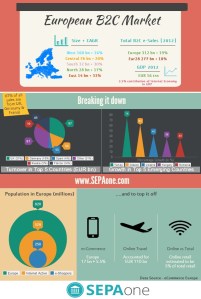
<p>One explanation for this is that in Germany and Austria, the Legacy system (the Direct Debit system prior to SEPA Direct Debit) had a payment timeline of <span style="color:#61acb1;">1 Business day</span>. When the Core scheme was implemented, this was raised to <span style="color:#61acb1;">2 Business days</span>, prompting German and Austrian merchants to demand a faster system and thus giving rise to the COR1 scheme. The French legacy system has the same payment timeline as the Core scheme, and hence the French merchants have not been very proactive in the uptake of the COR1 scheme.</p>]]></content><author><name></name></author><summary type="html"><![CDATA[The Deutsche Bundesbank recently released data on the implementation of SEPA Direct Debit by all the Banks across the member states. We analyzed this data and here are our key findings: SEPA Direct Debit availability for EU5 + Austria: Country  Core Scheme by % of Bank Branches  Core Scheme by number of Bank Branches COR1 Scheme by % of Bank Branches COR1 Scheme by number of Bank Branches Germany 99% 6405 98% 6392 Italy 97% 24720 3% 980 France 99% 1553 1% 17 Austria 98% 1052 98% 1050 Spain 97% 311 90% 291 UK 10% 984 0.5% 62 (for all other countries, please refer to our complete list) The deadline for the SEPA Direct Debit implementation in all the Eurozone member states is August 2014, whereas for the non Eurozone states, it is October 2016. This would explain why the implementation of SEPA Direct Debit is much lower in UK Banks when compared to the others in the above table. At the time of writing this article, the following Eurozone states have less than 50% availability of the Core scheme (by number of Bank branches) : Estonia (7%) Latvia (3%) Luxembourg (32%) Malta (29%) The COR1 scheme implementation varies widely across the member states, with highest prevalence among Germany, Austria and Spain. Italy and France have been rather slow in COR1 scheme implementation, despite a high rate of Core scheme implementation. One explanation for this is that in Germany and Austria, the Legacy system (the Direct Debit system prior to SEPA Direct Debit) had a payment timeline of 1 Business day. When the Core scheme was implemented, this was raised to 2 Business days, prompting German and Austrian merchants to demand a faster system and thus giving rise to the COR1 scheme. The French legacy system has the same payment timeline as the Core scheme, and hence the French merchants have not been very proactive in the uptake of the COR1 scheme.]]></summary></entry><entry><title type="html">The European B2C Market</title><link href="https://blog.sepaone.com/2014/08/19/25/" rel="alternate" type="text/html" title="The European B2C Market" /><published>2014-08-19T17:01:03+00:00</published><updated>2014-08-19T17:01:03+00:00</updated><id>https://blog.sepaone.com/2014/08/19/25</id><content type="html" xml:base="https://blog.sepaone.com/2014/08/19/25/"><![CDATA[<p>According to <strong><a href="http://www.emarketer.com/Article/Global-B2C-Ecommerce-Sales-Hit-15-Trillion-This-Year-Driven-by-Growth-Emerging-Markets/1010575">eMarketer’s latest forecasts</a></strong>, worldwide business to customer (B2C) eCommerce sales will increase by <span style="color:#61acb1;">20.1%</span> this year to reach <span style="color:#61acb1;">EUR 1.1 trillion</span>. Growth comes primarily from rapidly expanding online and mobile user bases in emerging markets, increases in mCommerce sales and advanced shipping and payment options.</p>
<p>In <span style="color:#61acb1;">2012</span>, Europe accounted for close to <span style="color:#61acb1;">EUR 312 Billion</span> in eCommerce sales. The Western European region, including Belgium, France, Ireland, Luxembourg , The Netherlands and the UK, was in the 1st position for e-commerce size, with a <span style="color:#61acb1;">51%</span> European market share. The total B2C eCommerce sales of W.Europe closed at <span style="color:#61acb1;">EUR 160 Billion</span>, a <span style="color:#61acb1;">20%</span> growth compared to <span style="color:#61acb1;">2011</span>.</p>
<p>The size of the market and the number of e-shoppers provide a massive incentive for businesses to implement <span style="color:#61acb1;">SEPA Direct Debit</span> as one of their payment models. The simplicity and security of this payment system give customers a great user experience while shopping; one of the key factors to acquire repeat customers.</p>
<p>Here is an infographic breaking the market down:</p>
<p><a href="/assets/images/5-a-eu-b2c-infographic.jpg"><img data-attachment-id="26" data-permalink="http://blog.sepaone.com/2014/08/19/25/5-a-eu-b2c-infographic/" data-orig-file="/assets/images/5-a-eu-b2c-infographic.jpg" data-orig-size="800,1193" data-comments-opened="1" data-image-meta="{&quot;aperture&quot;:&quot;0&quot;,&quot;credit&quot;:&quot;&quot;,&quot;camera&quot;:&quot;&quot;,&quot;caption&quot;:&quot;&quot;,&quot;created_timestamp&quot;:&quot;0&quot;,&quot;copyright&quot;:&quot;&quot;,&quot;focal_length&quot;:&quot;0&quot;,&quot;iso&quot;:&quot;0&quot;,&quot;shutter_speed&quot;:&quot;0&quot;,&quot;title&quot;:&quot;&quot;,&quot;orientation&quot;:&quot;0&quot;}" data-image-title="5.a EU B2C infographic" data-image-description="" data-image-caption="" data-large-file="/assets/images/5-a-eu-b2c-infographic.jpg" loading="lazy" class="alignnone size-medium wp-image-26" src="/assets/images/5-a-eu-b2c-infographic.jpg" alt="5.a EU B2C infographic" width="201" height="300" srcset="/assets/images/5-a-eu-b2c-infographic.jpg 201w, /assets/images/5-a-eu-b2c-infographic.jpg 402w, /assets/images/5-a-eu-b2c-infographic.jpg 101w" sizes="auto, (max-width: 201px) 100vw, 201px" /></a></p>]]></content><author><name></name></author><summary type="html"><![CDATA[According to eMarketer’s latest forecasts, worldwide business to customer (B2C) eCommerce sales will increase by 20.1% this year to reach EUR 1.1 trillion. Growth comes primarily from rapidly expanding online and mobile user bases in emerging markets, increases in mCommerce sales and advanced shipping and payment options. In 2012, Europe accounted for close to EUR 312 Billion in eCommerce sales. The Western European region, including Belgium, France, Ireland, Luxembourg , The Netherlands and the UK, was in the 1st position for e-commerce size, with a 51% European market share. The total B2C eCommerce sales of W.Europe closed at EUR 160 Billion, a 20% growth compared to 2011. The size of the market and the number of e-shoppers provide a massive incentive for businesses to implement SEPA Direct Debit as one of their payment models. The simplicity and security of this payment system give customers a great user experience while shopping; one of the key factors to acquire repeat customers. Here is an infographic breaking the market down:]]></summary></entry><entry><title type="html">What are the advantages of using SEPAone?</title><link href="https://blog.sepaone.com/2014/08/19/22/" rel="alternate" type="text/html" title="What are the advantages of using SEPAone?" /><published>2014-08-19T16:56:28+00:00</published><updated>2014-08-19T16:56:28+00:00</updated><id>https://blog.sepaone.com/2014/08/19/22</id><content type="html" xml:base="https://blog.sepaone.com/2014/08/19/22/"><![CDATA[<p>SEPAone is a <span style="color:#61acb1;">SEPA Direct Debit enabler</span>. Our focus is on providing Payment Service Providers (PSPs) and Merchants with the proper tools, so they can offer Direct Debits to their clients. Think of SEPAone as <span style="color:#61acb1;"> Stripe for Direct Debit in Europe</span>. We have created a simple way for businesses to set-up and accept Direct Debit payments over the internet and through multiple platforms.</p>
<p><a href="www.sepaone.com" target="_blank"><span style="color:#61acb1;">SEPAone</span></a> was founded by entrepreneurs who have years of experience in the payments industry. We learned a great deal about Direct Debit from the likes of PayPal and Amazon, and strongly believe in its future.</p>
<p>To put it simply, here is why you should use us:</p>
<blockquote>
<ul>
<li><span style="color:#61acb1;">Great User Experience</span>. We provide native integration (no redirects) for both online and mobile checkouts</li>
<li><span style="color:#61acb1;">Simplicity</span>. No intermediaries, no wallets, no passwords. IBAN/BIC is also not required. We automatically calculate this from the Account number/Sort code</li>
<li><span style="color:#61acb1;">Easy integration</span> with RESTful API.</li>
<li><span style="color:#61acb1;">Peace of mind</span>. We handle chargebacks and reminders.</li>
<li><span style="color:#61acb1;">No Bank integration</span> is needed.</li>
<li><span style="color:#61acb1;">Cross platform</span>. PC, Mobile and Tablets.</li>
<li><span style="color:#61acb1;">Mandate Management</span>. We handle creation, modification and cancellation of all Mandates</li>
<li><span style="color:#61acb1;">Advanced Features</span>. Easy refunds, reconciliation, debtor management, reminders through eMail and Snail Mail</li>
<li><span style="color:#61acb1;">Transaction Handling</span>. Both CORE and COR1, standard checks, pre-notification emails.</li>
<li><span style="color:#61acb1;">R-Transaction Handling</span>. Receiving R-Transactions from banks, generating reports, helping Businesses handle refund claims.</li>
<li><span style="color:#61acb1;">Panel</span>. An overview dashboard (Mandates, Customers, Transactions and Refunds), Transaction stream, search functionality, etc.</li>
</ul>
</blockquote>]]></content><author><name></name></author><summary type="html"><![CDATA[SEPAone is a SEPA Direct Debit enabler. Our focus is on providing Payment Service Providers (PSPs) and Merchants with the proper tools, so they can offer Direct Debits to their clients. Think of SEPAone as Stripe for Direct Debit in Europe. We have created a simple way for businesses to set-up and accept Direct Debit payments over the internet and through multiple platforms. SEPAone was founded by entrepreneurs who have years of experience in the payments industry. We learned a great deal about Direct Debit from the likes of PayPal and Amazon, and strongly believe in its future. To put it simply, here is why you should use us: Great User Experience. We provide native integration (no redirects) for both online and mobile checkouts Simplicity. No intermediaries, no wallets, no passwords. IBAN/BIC is also not required. We automatically calculate this from the Account number/Sort code Easy integration with RESTful API. Peace of mind. We handle chargebacks and reminders. No Bank integration is needed. Cross platform. PC, Mobile and Tablets. Mandate Management. We handle creation, modification and cancellation of all Mandates Advanced Features. Easy refunds, reconciliation, debtor management, reminders through eMail and Snail Mail Transaction Handling. Both CORE and COR1, standard checks, pre-notification emails. R-Transaction Handling. Receiving R-Transactions from banks, generating reports, helping Businesses handle refund claims. Panel. An overview dashboard (Mandates, Customers, Transactions and Refunds), Transaction stream, search functionality, etc.]]></summary></entry><entry><title type="html">How do I implement SEPA Direct Debit for my Business?</title><link href="https://blog.sepaone.com/2014/08/19/how-do-i-implement-sepa-direct-debit-for-my-business/" rel="alternate" type="text/html" title="How do I implement SEPA Direct Debit for my Business?" /><published>2014-08-19T16:51:10+00:00</published><updated>2014-08-19T16:51:10+00:00</updated><id>https://blog.sepaone.com/2014/08/19/how-do-i-implement-sepa-direct-debit-for-my-business</id><content type="html" xml:base="https://blog.sepaone.com/2014/08/19/how-do-i-implement-sepa-direct-debit-for-my-business/"><![CDATA[<p>There are 2 ways to set up SEPA Direct Debit for your business.</p>
<p>a. Do it yourself<br />
b. Use a Direct Debit enabler, such as<a href="www.sepaone.com" target="_blank"><span style="color:#61acb1;"> SEPAone </span></a></p>
<p>There are various steps to be taken and technological processes to be implemented before you can successfully start using SEPA Direct Debit for your business. We have outlined below what the process might look like for you. Please note that the process may vary based on your location and government regulations.</p>
<p>&nbsp;</p>
<h4>1. <span style="color:#61acb1;">Have a bank account within the SEPA zone</span></h4>
<p>A bank account within the SEPA zone is required to use SEPA Direct Debits for your business.</p>
<hr />

<h4>2. <span style="color:#61acb1;">Acquire a Creditor Identifier:</span></h4>
<p>A Creditor Identifier is a unique code that is used as a reference for every SEPA Direct Debit merchant. The process and timing of acquiring a Creditor Identifier depends on the country you are registered. For example:</p>
<blockquote>
<ul>
<li><span style="color:brown;">Germany</span> &#8211; The merchant has to visit the <a href="https://extranet.bundesbank.de/scp/" target="_blank">Deutsche Bundesbank</a> webpage where they can apply for a Creditor Identifier. The process takes 1 business day.</li>
<li><span style="color:brown;">France &amp; Italy </span> &#8211; The merchant has to contact their own bank and request for a Creditor Identifier, which will in turn apply for one, on the merchant’s behalf.</li>
<li><span style="color:brown;">UK</span> &#8211; The merchant has to contact their own bank and request for a Creditor Identifier, which will in turn apply for one, on the merchant’s behalf. Some banks may have certain requirements that merchants need to meet (monetary reserves, expertise/knowledge of SEPA Direct Debit)</li>
</ul>
</blockquote>
<hr />

<h4>3. <span style="color:#61acb1;">Implement Click Mandates:</span></h4>
<p>Once you have the Creditor Identifier, you need to get your bank to accept Click Mandates (only certain banks provide this capability or are willing to do so).</p>
<p><em>SEPAone works with partner banks that accept Click Mandates.</em></p>
<hr />

<h4>4. <span style="color:#61acb1;">Manage Credit risk:</span></h4>
<p>The bank will require protection against any possible risks from chargebacks on their behalf. Banks will set a credit limit and some may even ask for collateral.</p>
<p><em>SEPAone can manage the credit risk for you, by monitoring transactions and chargeback rates.</em></p>
<hr />

<h4>5. <span style="color:#61acb1;">Implement the Technology:</span></h4>
<p>You will need to go through a complex, time consuming and expensive process of connecting your Frontend and Backend to the bank, through different technological frameworks such as <span style="color:brown;">EBICS or HBCI </span>(depending on what the bank offers and your legacy software requirements), in order to activate Direct Debit.</p>
<p><em>SEPAone has developed the required technology; all you need to do is use our simple API and start receiving payments through SEPA Direct Debit.</em></p>
<hr />

<h4>6. <span style="color:#61acb1;">Convert to IBAN/BIC format:</span></h4>
<p>Most customers do not know their <span style="color:brown;">IBAN and BIC </span>and do not have them handy at checkout. They are used to their legacy credentials such as their Account number and (in many countries) Bank Sorting number.</p>
<p>To prevent this<span style="color:brown;"> IBAN conversion killer</span>, you might want to implement an IBAN/BIC converter.</p>
<p><em>SEPAone accepts IBAN, BIC or the legacy account details. Your customer can decide what they prefer to enter.</em></p>
<hr />

<h4>7. <span style="color:#61acb1;">Implement a Mandate Management System: </span></h4>
<p>Specific guidelines set out by European Payment Council have to be followed in order to manage Mandates. In general:</p>
<blockquote>
<ul>
<li>All <span style="color:brown;">Paper Mandates</span> must be stored by the Business either in the original form or as a digitized document. The data in <span style="color:brown;">Click Mandates</span> must be stored as presented by the customer.</li>
<li>These mandates must be stored for as long as they are valid, or for a <span style="color:brown;">minimum of 14 months</span> after the last collection.</li>
<li>Both the customer and the Business can modify a Mandate at any time, in some cases based on mutual agreement.</li>
</ul>
</blockquote>
<p>If you have used Direct Debit before SEPA, you will need to review all the existing mandates and make sure they fit the SEPA Direct Debit requirements, as well as allowing for the creation of new mandates. Any missing information fields will need to be updated, and a unique reference must be assigned to the mandate.</p>
<p><em>SEPAone can handle all of your Mandate Management needs, including but not limited to:</em></p>
<blockquote>
<ul>
<li><em>Creation of one-off and recurring mandates.</em></li>
<li><em>Generating mandate references.</em></li>
<li><em>Handling cancelled and expired mandates.</em></li>
</ul>
</blockquote>
<hr />

<h4>8. <span style="color:#61acb1;">Implement Credit Scoring/ Risk Management:</span></h4>
<p>Though optional, this is an important feature to have in order to reduce your financial risk. By implementing a scoring system, you can greatly reduce your chargeback rates, fraud and credit risk.</p>
<p><em>SEPAone has a user scoring system which we use to validate each request, thus reducing your risk.</em></p>
<hr />

<h4>9. <span style="color:#61acb1;">Decide between the Core and COR1 Scheme: </span></h4>
<p>Depending on your location and the schemes offered by your bank, you may have the option of implementing the faster COR1 scheme. The availability of COR1 consumer accounts is almost<span style="color:brown;"> 100% in Germany and Austria, with Spain following at over 90%</span>, whereas it is still growing in availability in other SEPA member states countries.</p>
<p><em>Please refer to our SEPA Direct Debit Availability Research for more information.</em></p>
<hr />

<h4>10. <span style="color:#61acb1;">Implement Pre-notification processes: </span></h4>
<p>In general customers must be notified <span style="color:brown;">14 days in advance</span> of any payment collection. It is however possible to reduce this advance notification period through mutual agreement with a customer. We advise to do so in your terms and conditions.</p>
<p><em>SEPAone can send pre-notifications to customers on your behalf, through both eMails as well as Snail Mails. We also provide you with a standard language that you can use in your terms and conditions to shorten the pre-notification period.</em></p>
<hr />

<h4>11. <span style="color:#61acb1;">Implement Transaction and R-Transaction processes: </span></h4>
<p>You will need to implement robust Transaction and R-Transaction processes. As a merchant or a customer, you have the possibility to request cancellation of a SEPA Direct Debit request that you have already initiated. A transaction that has already been processed can be reversed afterwards.</p>
<p>Here is a summary of the various possibilities for R-Transactions:</p>
<table class="data-table">
<tbody>
<tr>
<th class="border-top border-bottom border-left border-right">Initiated By</th>
<th class="border-top border-bottom border-right">Before Due Date</th>
<th class="border-top border-bottom border-right">After Due Date</th>
</tr>
<tr>
<td class="border-bottom border-left border-right">Merchant</td>
<td class="border-bottom border-right">Revocation; Request for Cancellation</td>
<td class="border-bottom border-right">Reversal: within 5 Business days</td>
</tr>
<tr>
<td class="border-bottom border-left border-right">Customer or Customer&#8217;s Bank</td>
<td class="border-bottom border-right">Refusal by Customer or Customer&#8217;s Bank</td>
<td class="border-bottom border-right">Return by Bank within 5 Business days; Refund for Customer within 8 weeks; Refund for Unauthorized Transaction within 13 months</td>
</tr>
</tbody>
</table>
<p>Refusal by Customer can occur due to reasons such as:</p>
<blockquote>
<ul>
<li>Customer has <span style="color:brown;">blocked a merchant</span> from collecting SEPA Direct Debits from their account</li>
<li>Customer has set a <span style="color:brown;">maximum payment amount</span> and/or <span style="color:brown;">payment period</span>.</li>
</ul>
</blockquote>
<p>Refusal by Customer’s bank can occur due to the several reasons such as:</p>
<blockquote>
<ul>
<li><span style="color:brown;">Account number problems</span> (Incorrect/Closed/Blocked, etc)</li>
<li><span style="color:brown;">Mandate problems</span> (Non-existent/Expired/Missing Information, etc)</li>
</ul>
</blockquote>
<p>In case of an R-transaction you may want to contact the customer and give them the opportunity to pay with another payment method within a period of time.</p>
<p>Apart from R-Transaction handling, the following processes may also be implemented:</p>
<blockquote>
<ul>
<li><span style="color:brown;">Collection handovers</span> &#8211; In case the customer hasn’t paid even after the additional amount of time, you might want to have an external party take care of the collection process.</li>
<li><span style="color:brown;">Monitoring system</span> for the above processes</li>
</ul>
</blockquote>
<p><em>With SEPAone you have support for all of this, as well as:</em></p>
<blockquote>
<ul>
<li><em>Support for both CORE and COR1 schemes.</em></li>
<li><em>Plausibility checks.</em></li>
<li><em>Pre-notification emails to customers.</em></li>
<li><em>Handling R-transactions and Reporting through API.</em></li>
</ul>
</blockquote>
<hr />

<h4>11. <span style="color:#61acb1;">Implement a Refund processes: </span></h4>
<p>Imagine a situation where a customer returns a good, six days after the due date. You would like to refund this customer. In this case you have to extract your customer account details and transfer back the money to his account. This is a usual bank transaction.</p>
<p>There is a fraud risk involved here, because the customer can still send a refund request through his bank.</p>
<p><em>With SEPAone you have support for creating a robust Refund process, as well as:</em></p>
<blockquote>
<ul>
<li><em>Easy initiation of a refund with reference to initial Direct Debit transaction</em></li>
<li><em>Monitoring and alerts for R-Transaction after refunds</em></li>
</ul>
</blockquote>
<hr />]]></content><author><name></name></author><summary type="html"><![CDATA[There are 2 ways to set up SEPA Direct Debit for your business. a. Do it yourself b. Use a Direct Debit enabler, such as SEPAone There are various steps to be taken and technological processes to be implemented before you can successfully start using SEPA Direct Debit for your business. We have outlined below what the process might look like for you. Please note that the process may vary based on your location and government regulations. &nbsp; 1. Have a bank account within the SEPA zone A bank account within the SEPA zone is required to use SEPA Direct Debits for your business. 2. Acquire a Creditor Identifier: A Creditor Identifier is a unique code that is used as a reference for every SEPA Direct Debit merchant. The process and timing of acquiring a Creditor Identifier depends on the country you are registered. For example: Germany &#8211; The merchant has to visit the Deutsche Bundesbank webpage where they can apply for a Creditor Identifier. The process takes 1 business day. France &amp; Italy &#8211; The merchant has to contact their own bank and request for a Creditor Identifier, which will in turn apply for one, on the merchant’s behalf. UK &#8211; The merchant has to contact their own bank and request for a Creditor Identifier, which will in turn apply for one, on the merchant’s behalf. Some banks may have certain requirements that merchants need to meet (monetary reserves, expertise/knowledge of SEPA Direct Debit) 3. Implement Click Mandates: Once you have the Creditor Identifier, you need to get your bank to accept Click Mandates (only certain banks provide this capability or are willing to do so). SEPAone works with partner banks that accept Click Mandates. 4. Manage Credit risk: The bank will require protection against any possible risks from chargebacks on their behalf. Banks will set a credit limit and some may even ask for collateral. SEPAone can manage the credit risk for you, by monitoring transactions and chargeback rates. 5. Implement the Technology: You will need to go through a complex, time consuming and expensive process of connecting your Frontend and Backend to the bank, through different technological frameworks such as EBICS or HBCI (depending on what the bank offers and your legacy software requirements), in order to activate Direct Debit. SEPAone has developed the required technology; all you need to do is use our simple API and start receiving payments through SEPA Direct Debit. 6. Convert to IBAN/BIC format: Most customers do not know their IBAN and BIC and do not have them handy at checkout. They are used to their legacy credentials such as their Account number and (in many countries) Bank Sorting number. To prevent this IBAN conversion killer, you might want to implement an IBAN/BIC converter. SEPAone accepts IBAN, BIC or the legacy account details. Your customer can decide what they prefer to enter. 7. Implement a Mandate Management System: Specific guidelines set out by European Payment Council have to be followed in order to manage Mandates. In general: All Paper Mandates must be stored by the Business either in the original form or as a digitized document. The data in Click Mandates must be stored as presented by the customer. These mandates must be stored for as long as they are valid, or for a minimum of 14 months after the last collection. Both the customer and the Business can modify a Mandate at any time, in some cases based on mutual agreement. If you have used Direct Debit before SEPA, you will need to review all the existing mandates and make sure they fit the SEPA Direct Debit requirements, as well as allowing for the creation of new mandates. Any missing information fields will need to be updated, and a unique reference must be assigned to the mandate. SEPAone can handle all of your Mandate Management needs, including but not limited to: Creation of one-off and recurring mandates. Generating mandate references. Handling cancelled and expired mandates. 8. Implement Credit Scoring/ Risk Management: Though optional, this is an important feature to have in order to reduce your financial risk. By implementing a scoring system, you can greatly reduce your chargeback rates, fraud and credit risk. SEPAone has a user scoring system which we use to validate each request, thus reducing your risk. 9. Decide between the Core and COR1 Scheme: Depending on your location and the schemes offered by your bank, you may have the option of implementing the faster COR1 scheme. The availability of COR1 consumer accounts is almost 100% in Germany and Austria, with Spain following at over 90%, whereas it is still growing in availability in other SEPA member states countries. Please refer to our SEPA Direct Debit Availability Research for more information. 10. Implement Pre-notification processes: In general customers must be notified 14 days in advance of any payment collection. It is however possible to reduce this advance notification period through mutual agreement with a customer. We advise to do so in your terms and conditions. SEPAone can send pre-notifications to customers on your behalf, through both eMails as well as Snail Mails. We also provide you with a standard language that you can use in your terms and conditions to shorten the pre-notification period. 11. Implement Transaction and R-Transaction processes: You will need to implement robust Transaction and R-Transaction processes. As a merchant or a customer, you have the possibility to request cancellation of a SEPA Direct Debit request that you have already initiated. A transaction that has already been processed can be reversed afterwards. Here is a summary of the various possibilities for R-Transactions: Initiated By Before Due Date After Due Date Merchant Revocation; Request for Cancellation Reversal: within 5 Business days Customer or Customer&#8217;s Bank Refusal by Customer or Customer&#8217;s Bank Return by Bank within 5 Business days; Refund for Customer within 8 weeks; Refund for Unauthorized Transaction within 13 months Refusal by Customer can occur due to reasons such as: Customer has blocked a merchant from collecting SEPA Direct Debits from their account Customer has set a maximum payment amount and/or payment period. Refusal by Customer’s bank can occur due to the several reasons such as: Account number problems (Incorrect/Closed/Blocked, etc) Mandate problems (Non-existent/Expired/Missing Information, etc) In case of an R-transaction you may want to contact the customer and give them the opportunity to pay with another payment method within a period of time. Apart from R-Transaction handling, the following processes may also be implemented: Collection handovers &#8211; In case the customer hasn’t paid even after the additional amount of time, you might want to have an external party take care of the collection process. Monitoring system for the above processes With SEPAone you have support for all of this, as well as: Support for both CORE and COR1 schemes. Plausibility checks. Pre-notification emails to customers. Handling R-transactions and Reporting through API. 11. Implement a Refund processes: Imagine a situation where a customer returns a good, six days after the due date. You would like to refund this customer. In this case you have to extract your customer account details and transfer back the money to his account. This is a usual bank transaction. There is a fraud risk involved here, because the customer can still send a refund request through his bank. With SEPAone you have support for creating a robust Refund process, as well as: Easy initiation of a refund with reference to initial Direct Debit transaction Monitoring and alerts for R-Transaction after refunds]]></summary></entry><entry><title type="html">What’s so great about SEPA Direct Debit?</title><link href="https://blog.sepaone.com/2014/08/19/whats-so-great-about-sepa-direct-debit/" rel="alternate" type="text/html" title="What’s so great about SEPA Direct Debit?" /><published>2014-08-19T16:33:47+00:00</published><updated>2014-08-19T16:33:47+00:00</updated><id>https://blog.sepaone.com/2014/08/19/whats-so-great-about-sepa-direct-debit</id><content type="html" xml:base="https://blog.sepaone.com/2014/08/19/whats-so-great-about-sepa-direct-debit/"><![CDATA[<p>In the current payment system, businesses face a lot of difficulties in collecting payments from other SEPA countries. Due to the differences in payment models, these payments often require different formats and data elements. Taking these payments is usually expensive and time consuming.</p>
<p>The SEPA Direct Debit scheme simplifies the collection of payments across multiple countries, by defragmenting the payment procedures. This will allow customers as well as businesses to make payments across the SEPA member states just as they make domestic payments.</p>
<p>&nbsp;</p>
<hr />

<h2>What are the advantages for businesses?</h2>
<p>The advantages for business include, but are not limited to:</p>
<blockquote>
<ul>
<li><span style="color:#61acb1;">Optimizing cash management</span>. Businesses now know exactly when payments will be received from any of the SEPA member states.</li>
<li><span style="color:#61acb1;">Reliability in cash flow</span>. Payment completion within a pre-determined cash cycle.</li>
<li><span style="color:#61acb1;">Economies of Scale</span>. By removing the costs involved in collecting payments from other SEPA member states.</li>
<li><span style="color:#61acb1;">Expanding your business</span>. By making it simpler to collect payments from across Europe.</li>
<li><span style="color:#61acb1;">Automation</span>. Ability to automate handling of refunds, rejections and returns.</li>
</ul>
</blockquote>
<hr />

<h2>What are the advantages for customers?</h2>
<p>The advantages for customers include, but are not limited to:</p>
<blockquote>
<ul>
<li><span style="color:#61acb1;">Simple and secure</span> method to pay bills across 33 SEPA member states.</li>
<li>Payers don’t have to deal with consequences of <span style="color:#61acb1;">late payments</span>.</li>
<li><span style="color:#61acb1;"> Easy reconciliation</span> of debits on account statements.</li>
</ul>
</blockquote>
<hr />

<h2>How does SEPA Direct Debit differ from the current payment model?</h2>
<p>Overall, the following differences can be seen between the current payment model and the SEPA DD scheme:</p>
<blockquote>
<ul>
<li><span style="color:#61acb1;">Unification</span> of payment systems and data flows, which currently vary between each member country</li>
<li><span style="color:#61acb1;">Uniformity</span> in customer experience across the member states</li>
<li><span style="color:#61acb1;">Reduction in complexity</span>, improved security and efficiency</li>
<li><span style="color:#61acb1;">Single account</span> for trading activities in multiple markets</li>
</ul>
</blockquote>
<hr />]]></content><author><name></name></author><summary type="html"><![CDATA[In the current payment system, businesses face a lot of difficulties in collecting payments from other SEPA countries. Due to the differences in payment models, these payments often require different formats and data elements. Taking these payments is usually expensive and time consuming. The SEPA Direct Debit scheme simplifies the collection of payments across multiple countries, by defragmenting the payment procedures. This will allow customers as well as businesses to make payments across the SEPA member states just as they make domestic payments. &nbsp; What are the advantages for businesses? The advantages for business include, but are not limited to: Optimizing cash management. Businesses now know exactly when payments will be received from any of the SEPA member states. Reliability in cash flow. Payment completion within a pre-determined cash cycle. Economies of Scale. By removing the costs involved in collecting payments from other SEPA member states. Expanding your business. By making it simpler to collect payments from across Europe. Automation. Ability to automate handling of refunds, rejections and returns. What are the advantages for customers? The advantages for customers include, but are not limited to: Simple and secure method to pay bills across 33 SEPA member states. Payers don’t have to deal with consequences of late payments. Easy reconciliation of debits on account statements. How does SEPA Direct Debit differ from the current payment model? Overall, the following differences can be seen between the current payment model and the SEPA DD scheme: Unification of payment systems and data flows, which currently vary between each member country Uniformity in customer experience across the member states Reduction in complexity, improved security and efficiency Single account for trading activities in multiple markets]]></summary></entry></feed>